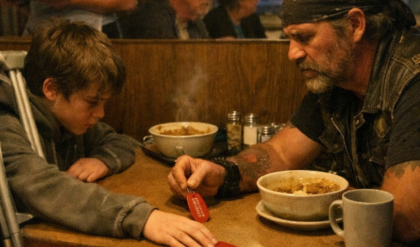
The Waitress Was Fired for Warning a “Homeless” Man Not to Eat the Steak After Hearing the Manager Order Spoiled Food Be Served — “You Just Cost Yourself Your Job,” He Announced, But the Moment the Man Revealed He Had Recorded Everything and Was the Restaurant’s Real Owner, the Truth Shut the Entire Room Down
There are moments that begin so quietly you almost miss the weight of them, the kind that slip into an ordinary evening without asking permission, only to unfold into something that rearranges everything you thought you understood about power, dignity, and the invisible lines between people who serve and people who are served.
On that particular night in downtown Chicago, the wind moved between glass towers with a sharpness that hinted at winter coming early, and inside a place called The Golden Ranch—one of the city’s most polished restaurants—everything appeared exactly as it was designed to be: controlled, elegant, and comfortably detached from anything messy or human.
No one noticed the man at first.
Or rather, they noticed him only in the way people notice something out of place and immediately try to ignore it. His coat was worn past the point of repair, the fabric thinning at the elbows where time had pressed itself into it, and his shoes carried the dust of streets that didn’t belong in a place where even the floors reflected light like polished glass. Yet there was something about him that resisted dismissal, something in the way he stood—not hesitant, not apologetic, but still, observant, as if he were measuring the room rather than seeking approval from it.
At the hostess stand, a young woman named Brielle hesitated before offering the practiced smile she had learned to use when situations became uncomfortable.
“I’m sorry, sir,” she said gently, lowering her voice so it wouldn’t travel. “We require—”
“I’ll pay,” the man interrupted, not raising his tone, but placing a small stack of cash on the counter with a quiet certainty that cut through the polished atmosphere more effectively than any raised voice could have.
The manager on duty, a man named Gregory Pike, appeared almost immediately, drawn not by the money but by the disruption. Gregory had built his reputation on control—on the ability to maintain appearances no matter what—and in his world, appearances mattered more than anything that might contradict them.
“Sir,” Gregory said, his smile tight and professional, “this establishment maintains certain standards.”
The man met his gaze without flinching. “Then meet them,” he replied simply.
There was a brief pause, the kind that stretches longer than it should because no one knows exactly how to resolve it without losing face. Then Gregory forced a softer smile, gestured toward the back corner of the restaurant—the least visible table, near the kitchen doors—and said, “Of course. Right this way.”
That was how the man came to sit at table fourteen, the one most guests never noticed, the one reserved for inconvenience.
And that was how he came under the care of Marisol Vega.
Marisol had been working double shifts for three weeks straight, the kind of schedule that turned time into something blurry and indistinct, where days merged into each other and exhaustion became a permanent background noise. She moved with efficiency rather than energy, her steps measured, her voice steady, her smile practiced but not empty. There was a difference, subtle but important.
She saw him the moment Gregory assigned the table. Not just saw him—but registered him. The posture. The eyes. The quiet.
And something in her paused.
Not long enough to draw attention. Just long enough to notice.
When she approached the table, she didn’t rush through the introduction the way she sometimes did at the end of a long shift.
“Good evening,” she said, her tone soft but steady. “My name is Marisol. I’ll be taking care of you tonight.”
The man looked up at her, and for a brief second, something unreadable passed through his expression—recognition, perhaps, or relief so faint it almost hid itself.
“Thank you,” he replied.
He didn’t order much. A simple steak. Water. Nothing that matched the price of the place he sat in.
But Marisol noticed something else.
The way he looked at the menu—not confused, not overwhelmed, but distant, as if it belonged to another life.

And later, when she passed near the kitchen, she heard Gregory’s voice.
“Use the returned cut,” he said sharply to the cook, a younger man named Theo who immediately stiffened. “It’s good enough for him.”
Theo hesitated. “It’s been sitting too long.”
Gregory leaned closer, lowering his voice in a way that made it more dangerous, not less. “And who exactly is going to complain?”
Marisol didn’t stop walking.
But something inside her did.
It would have been easy to ignore it. Easy to tell herself it wasn’t her responsibility. Easy to remember her rent, her younger sister’s tuition, the medication her mother needed every month without fail.
Easy to stay quiet.
Instead, she stepped into the restroom, locked the door behind her, and stared at her reflection for a moment that felt longer than it should have.
“You can walk away,” she whispered to herself.
Her reflection didn’t answer.
So she pulled a pen from her apron, tore a small piece from the back of her order pad, and wrote quickly, her hand trembling just enough to leave the letters uneven.
Don’t eat. Please trust me.
She folded it twice.
And when she returned to the table, she placed the plate down carefully, her movements steady, practiced—nothing to draw attention—and slipped the note beneath the edge of the dish where only he would find it.
Their eyes met for a fraction of a second.
Then she walked away.
That should have been the end of it.
But Gregory saw.
“Everyone’s attention, please,” he announced suddenly, his voice cutting through the room with a brightness that didn’t belong to the situation. Conversations stopped. Glasses paused mid-air. The soft hum of the restaurant collapsed into silence.
“This waitress,” he continued, gesturing toward Marisol, “has behaved inappropriately toward a guest. She is no longer employed here.”
The words landed quickly. Cleanly. Like a decision that had already been made long before it was spoken aloud.
Marisol didn’t argue immediately.
She stood there, the weight of dozens of eyes pressing against her, each one carrying its own version of judgment or indifference.
“I didn’t do anything wrong,” she said finally, her voice steady in a way that surprised even her.
Gregory’s smile sharpened. “Then you won’t mind leaving.”
No one moved.
No one spoke.
Because silence, in rooms like that, is often mistaken for neutrality.
Then a chair moved.
Slowly.
The man at table fourteen stood.
“She did nothing wrong,” he said.
His voice wasn’t loud. It didn’t need to be. There was something in it—something controlled, deliberate—that made people turn in a way they hadn’t before.
Gregory frowned. “Sir, this doesn’t concern you.”
The man tilted his head slightly, as if considering the statement rather than reacting to it.
“No,” he said after a moment. “It concerns exactly me.”
And then something changed.
Not in the room.
In him.
He reached down, removed one of his worn shoes, and from the inside lining—hidden, deliberate—he pulled out a slim device. A phone. Not the kind most people carried, but something quieter, more precise.
He pressed a button.
Thirty seconds passed.
Then the front doors opened.
Not dramatically. Not violently. Just decisively.
A woman in a tailored coat entered first, followed by two men in suits and another who carried himself with the unmistakable presence of legal authority.
The room shifted.
Because power, real power, doesn’t announce itself loudly. It arrives and lets the silence do the work.
The woman stepped forward. “Ladies and gentlemen,” she said calmly, “this is Nathaniel Rowe, founder and owner of The Golden Ranch Group.”
The words didn’t echo.
They didn’t need to.
They settled.
And everything that had seemed certain a moment before began to unravel.
Gregory’s face lost its color.
“That’s not—” he started, but the sentence didn’t finish itself.
Nathaniel—no longer the man at table fourteen, no longer invisible—looked at him with a calm that felt heavier than anger.
“I recorded the kitchen,” he said simply. “Every word.”
Silence broke into fragments.
Theo spoke first. Not loudly, but enough. Enough to shift everything.
“I told him it wasn’t safe,” he said, his voice shaking.
Gregory stepped back, but there was nowhere to go.
Because the truth, once it surfaces, doesn’t allow retreat.
Security arrived shortly after. Not rushed. Not chaotic. Just inevitable.
And as Gregory was escorted away, the room began to breathe again—uneven, uncertain breaths that carried the weight of what had just happened.
Marisol remained where she was.
Still.
Processing.
Nathaniel approached her slowly, as if aware that the moment required something more careful than authority.
“You knew,” he said quietly.
She nodded.
“And you still chose to act.”
Another nod.
“Why?” he asked.
It wasn’t a test.
It was a question that mattered.
Marisol met his eyes, and for the first time that night, there was no hesitation in her voice.
“Because someone should have,” she said.
He held her gaze for a moment longer than necessary, as if measuring the weight of that answer.
Then he nodded once.
Three months later, the restaurant reopened.
Not as it had been.
But as something different.
Warmer. Quieter. More aware of the people who moved through it—not just the ones who paid, but the ones who made it possible.
At the entrance, there was a small frame.
Inside it, a piece of paper.
Slightly wrinkled. Carefully preserved.
Don’t eat. Please trust me.
Below it, a simple line:
Dignity is not optional.
And behind the front desk, greeting guests with the same steady presence she once carried through exhaustion, stood Marisol Vega—no longer invisible, no longer just part of the background, but the one ensuring that no one who walked through those doors would ever be treated as less than they were worth.
Because sometimes, the smallest act of courage doesn’t just change a moment.
It changes the standard for everything that comes after.