The Little Girl Woke Up in the ICU and Asked, “Is the Biker Man Still Out There?” — The Nurse Thought It Was Just a Dream Until She Found the Paper Hidden Under the Pillow, But the Words Written on It Uncovered a Truth No One in That Hospital Could Ignore
People like to believe that when something unforgivable is happening to a child, there will be a moment loud enough to stop the world—a scream, a crash, a scene that demands intervention—but the truth is far quieter and far more unsettling, because sometimes the only warning is a single sentence spoken in a hospital room at three in the morning, when most of the world is asleep and only the ones who cannot afford to look away are still awake to hear it.
The night Eliza Rowan woke in the ICU, she didn’t ask for her guardian, didn’t ask for water, didn’t cry or panic the way the nurses had expected after reviewing her condition; instead, she turned her head slightly against the pillow, fingers curling weakly around a folded sheet of paper, and whispered in a voice so soft it almost blended with the hum of machines, “Is the biker man still out there?”
Nurse Marlene Hayes had been adjusting the IV line when she froze, not because she didn’t understand the words, but because she understood them too well—the way children choose one person, one memory, one fragile thread to hold onto when everything else has failed them.
“There’s no one outside right now, sweetheart,” she said gently, though something in her chest tightened as she spoke. “Do you want me to call someone for you?”
Eliza shook her head faintly, her eyelids already heavy again. “He said I mattered,” she murmured, as if explaining something important that adults always seemed to miss. “He said it like it was true.”
And then she slipped back into that uneasy, medicated sleep, leaving behind a sentence that refused to settle.
Marlene stood there longer than necessary before noticing the paper.
It had been tucked beneath the pillow, not hidden carelessly but placed with intention, like something that needed to stay close even in unconsciousness. She hesitated for only a second before unfolding it under the dim desk lamp, expecting perhaps a drawing or a note from school, something ordinary.
What she found was not ordinary.
On one side, a second-grade spelling test, marked in red ink with corrections and small encouraging notes written by a teacher who had likely never imagined where that paper would end up. On the other side, a drawing done with careful, deliberate strokes—a man on a motorcycle, broad shoulders, something like wings on his back, not precise but meaningful, and across his chest, written in thick, uneven letters pressed so hard the paper had nearly torn:
ARCHER
Below that, in the lower corner, three things written with even more force, as if the child had been afraid the words might disappear if she didn’t anchor them down:
364,000
incapacitated
spring
Marlene’s breath slowed.
Children didn’t write numbers like that without hearing them repeatedly.
They didn’t choose words like “incapacitated” unless those words had been spoken around them often enough to become part of their internal world.
And they certainly didn’t press hard enough to nearly break the paper unless they were trying to hold onto something they weren’t allowed to understand.
She didn’t wait.
Within minutes, the paper was in the hands of Harriet Cole, the senior hospital social worker whose experience had taught her to trust patterns over appearances and instincts over convenience.

Harriet read the paper once, then again, then a third time, not because she hadn’t understood it, but because she was already assembling the pieces behind it.
“Is she conscious?” Harriet asked.
“On and off,” Marlene replied. “She asked about someone. A biker.”
Harriet nodded slowly, her gaze still fixed on the drawing. “Children remember kindness,” she said quietly, more to herself than anyone else. “Especially when it’s rare.”
Within an hour, Harriet had accessed Eliza’s intake records, her medical history, and the guardianship file that had accompanied her admission.
Within two hours, the number appeared again.
Three hundred sixty-four thousand dollars.
It wasn’t random.
It was attached to a trust—established by Eliza’s late mother, structured with clauses that determined when and how the funds could be accessed.
And one clause stood out immediately.
If the child were declared medically incapable of managing her affairs over a sustained period, the acting guardian retained full control of the estate.
If not, oversight shifted elsewhere.
The hearing date was scheduled.
Eleven days.
Harriet leaned back, fingers steepled lightly, her expression unreadable but her mind already moving ahead.
“Who is the guardian?” Marlene asked.
Harriet flipped the page, her eyes narrowing slightly as she read.
“Victor Langford.”
The name sat there with the weight of something too polished to question at first glance.
But Harriet had learned long ago that the most dangerous people were rarely the loud ones.
They were the reasonable ones.
At 5:14 a.m., she made a call.
The phone rang only once.
“Yeah,” a voice answered, low and alert.
“Mr. Archer?” Harriet said. “My name is Harriet Cole. I’m calling from Hartfield Regional Hospital. There’s a little girl here who drew your name on a piece of paper and asked if you were still out there.”
Silence.
Then—
“How old?” he asked.
“Eight.”
A pause, shorter this time.
“I’m on my way.”
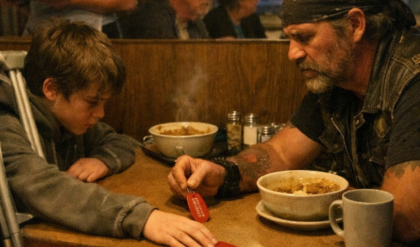
Jonas Archer arrived before sunrise had fully broken, his motorcycle rolling into the hospital parking lot with a controlled stillness that drew attention without demanding it. He removed his helmet slowly, revealing a face marked not just by time but by experience, the kind that left lines not of age but of endurance.
Inside, Harriet met him near the entrance.
“You came fast,” she said.
“She remembered me,” he replied simply.
That was enough explanation.
In the ICU room, the air felt different, as it always did around children who had endured too much.
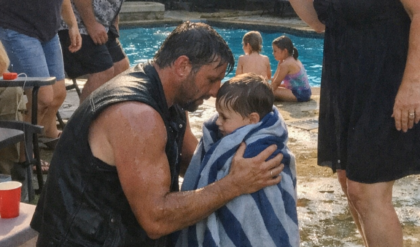
Jonas approached the bed with a care that contrasted sharply with his size, pulling a chair closer and lowering himself into it so that he was level with her when she woke.
It didn’t take long.
Something about presence has a way of reaching even through exhaustion.
Eliza’s eyes opened slowly.
For a moment, they were unfocused.
Then they found him.
Recognition moved through her face—not dramatic, not exaggerated, but certain.
“You came back,” she whispered.
“I said I would,” he answered.
She studied him, as if confirming that memory hadn’t betrayed her.
“I wrote the words,” she said, her voice fragile but determined. “I didn’t know what they meant.”
Jonas glanced at the paper, then back at her.
“That’s okay,” he said quietly. “You weren’t supposed to.”
Her fingers shifted slightly, brushing against the edge of the blanket.
“They say them at night,” she added. “They think I’m asleep.”
Jonas’s jaw tightened almost imperceptibly.
“You don’t have to listen to that anymore,” he said.
She watched him for a long moment, then asked the question that mattered most.
“You’re still out there?”
He didn’t hesitate.
“Yeah,” he said. “And I’m not going anywhere.”
That answer, simple as it was, settled something inside her.
Not completely.
Not all at once.
But enough.
What followed was not a single moment of justice, but a sequence of actions driven by people who refused to ignore what they had seen.
Harriet moved through legal channels with precision, requesting reviews, flagging inconsistencies, and ensuring that the case could no longer be dismissed as routine.
Medical records revealed patterns.
School reports confirmed prolonged absence.
Financial documents exposed urgency where patience should have existed.
And slowly, the structure surrounding Victor Langford began to unravel.
By the time the hearing arrived, it was no longer a formality.
It was an examination.
The courtroom carried a quiet tension, not loud but unmistakable, as evidence was presented and timelines reconstructed with clarity that left little room for interpretation.
Victor Langford maintained his composure, answering questions with calculated calm, presenting himself as a guardian managing difficult circumstances.
But the details no longer aligned.
Not when viewed together.
Not when challenged.
Not when the quiet persistence of those involved refused to allow gaps to remain unexamined.
Jonas did not sit alone.
He never had to ask.
Word travels differently among people who understand responsibility without needing it explained.
They came.
Not in chaos.
Not in disruption.
But in presence.
Rows filled with individuals who said nothing and yet made something unmistakably clear—this child was no longer invisible.
By the end of the hearing, the outcome was decisive.
Guardianship was revoked.
The trust secured.
An investigation initiated.
And the man who had relied on silence found himself facing a system that, finally, was paying attention.
Weeks later, the hospital room was gone, replaced by something quieter, warmer, filled with natural light instead of machines.
Eliza sat at a table with a fresh sheet of paper in front of her, a pencil held carefully between her fingers.
Harriet reviewed documents nearby.
Jonas stood by the window, arms loosely folded, not intruding, simply present.
“Can you help me spell something?” Eliza asked.
Jonas looked over.
“What word?”
She thought for a moment, then said, “Safe.”
He smiled slightly, stepping closer.
“Yeah,” he said. “I can help with that.”
She wrote slowly, carefully, each letter placed with intention.
When she finished, she looked up.
“Does it mean it stays?” she asked.
Harriet answered softly, her voice steady in the way that builds trust over time.
“It means you are,” she said.
Eliza nodded.
Then she looked at Jonas again.
“You’re still out there?” she asked, just to be sure.
He met her gaze without hesitation.
“Always,” he said.
And this time, when she believed it, it wasn’t because she needed something to hold onto.
It was because, finally, she didn’t have to hold on alone anymore.