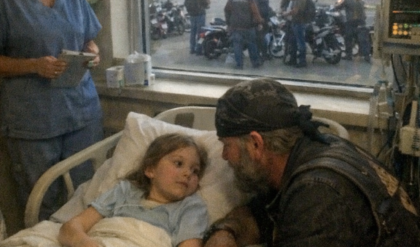
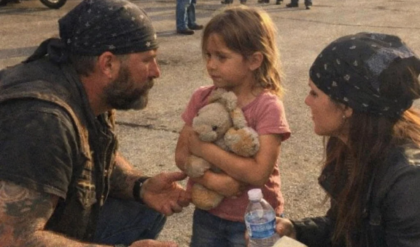
The Little Girl Refused to Leave an Injured Stranger on a Desolate Road Outside Bakersfield — “You Should Go Before They Find Me,” the Man Warned Weakly, But the Moment the Motorcycles Surrounded Them and Dozens of Riders Stepped Forward, What Happened Next Turned a Simple Act of Kindness Into Something No One There Would Ever Forget
There are moments in life that feel small when they begin, almost forgettable in the way ordinary afternoons blur together, and yet when you look back later, after everything has shifted and revealed itself, you realize that the entire direction of several lives turned on a decision made by someone who was not supposed to matter.
On that quiet stretch of road outside Bakersfield, with the wind moving lazily through dry grass and the sun lowering itself into a sky that looked too peaceful for anything terrible to exist beneath it, an eight-year-old girl knelt beside a man the world had already decided was beyond saving, and without understanding the weight of it, she chose not to walk away.
Her name was Sofia Alvarez, small for her age, with dark braids that never stayed neat and a habit of thinking longer than most children before she spoke, as if she sensed that words carried consequences adults often ignored. The man lying in the dirt beside the ruined motorcycle was named Victor “Graves” Rourke, a name spoken in certain parts of California with a mixture of caution and reluctant respect, the longtime president of a biker chapter that most people preferred to pretend didn’t exist.
At that moment, however, titles meant nothing. Power meant nothing. Reputation meant nothing.
There was only a man bleeding into the ground and a child who refused to leave.
“I’m not leaving,” Sofia repeated, even as her hands trembled and her heart pounded so hard she could feel it in her throat.
Victor’s breathing came shallow and uneven, his chest rising with effort that seemed too heavy for a single body to carry. He tried to focus on her, tried to understand why she was still there when instinct should have sent her running in the opposite direction.
“You don’t understand,” he managed, his voice rough, fractured by pain. “People who come looking for me… they don’t ask questions first.”
Sofia swallowed, her fingers hovering uncertainly above his arm before finally resting there, light and careful, like she was afraid he might break under even the smallest pressure.
“I understand enough,” she said quietly. “You’re hurt. That’s what matters right now.”
There was something disarming about the simplicity of it, something that bypassed years of hardened instinct and landed somewhere Victor had not allowed anyone to reach in a long time. He closed his eyes for a brief second, not in surrender, but in something dangerously close to relief.
“Phone,” he murmured. “In my jacket. Call for help.”
Sofia nodded quickly, her small hands fumbling through the torn leather until she found the device, its screen cracked but still alive. Her fingers hesitated for only a moment before she pressed the emergency number, her voice steady in a way that surprised even her as she explained what had happened, where they were, and that the man beside her was still breathing.
When she ended the call, the silence returned, thicker now, stretched by anticipation.
Victor shifted slightly, a wince cutting across his face as he tried to move his leg and failed. Sofia noticed immediately.
“Don’t move,” she said, echoing instructions she had once read in a book about first aid. “You’ll make it worse.”
He let out something that might have been a laugh if it hadn’t been buried under pain. “You always this bossy?”
“Only when people don’t listen,” she replied, and for a second, despite everything, there was a flicker of something lighter in the air between them.

Time stretched strangely after that, each second feeling longer than it should have, each sound amplified in the quiet. Sofia kept talking, not because she knew it would help medically, but because silence felt too heavy to carry.
“My mom says talking keeps people awake,” she explained, her eyes fixed on his face, watching for any sign that he might slip away. “So I’m going to keep talking.”
Victor didn’t argue. He didn’t have the strength.
“Okay,” he said softly.
She told him about school, about the books she liked, about how she hated math but loved anything that involved stories because stories made things feel possible. She spoke about her mother, about how tired she always looked and how she still managed to smile anyway, and somewhere in the middle of it all, without realizing it, Sofia gave him something he hadn’t known he needed.
A reason to stay.
The distant sound of engines came first, low and steady, rolling across the hills like an approaching storm.
Sofia froze.
Victor’s eyes opened sharply, awareness cutting through the haze of pain.
“They’re here,” he whispered, not with fear, but with a certainty that carried history behind it.
Within minutes, the road filled with motorcycles, their silhouettes cutting through the golden light as they came to a stop around the crash site. One by one, the riders dismounted, their movements controlled, alert, scanning everything at once.
There were many of them. More than Sofia could count quickly.
They looked exactly like the stories said they would.
And yet, as they approached, something unexpected happened.
They slowed.
Their focus shifted from the wrecked bike to the small figure kneeling beside their leader, her hand still wrapped gently around his.
A man stepped forward, older than the others, his expression hard until his eyes landed on Victor.
“Graves,” he said, his voice tight with concern he didn’t bother to hide. “What happened?”
“Road turned on me,” Victor replied weakly, then tilted his head slightly toward Sofia. “She stayed.”
The man’s gaze moved to her, studying her in a way that might have been intimidating if not for the quiet respect underneath it.
“You called it in?” he asked.
Sofia nodded.
“Yes, sir.”
He let out a slow breath, then gave a small, almost imperceptible nod.
“Good,” he said. “You did exactly right.”
The tension in the air shifted again, not disappearing, but changing shape, becoming something less threatening and more focused.
By the time the ambulance arrived, the scene had transformed into something no one present would ever forget. Riders stood back to make space, their presence forming a silent perimeter not of danger, but of protection. Sofia stayed until the paramedics took over, answering their questions, stepping back only when one of them gently guided her aside.
Victor reached for her before they lifted him onto the stretcher, his hand closing around hers with surprising strength.
“You didn’t walk away,” he said, his voice low but steady now. “That matters.”
Sofia hesitated, unsure what to say, then offered the only truth she had.
“My mom says people shouldn’t be left alone when they’re hurt.”
He held her gaze for a long second, something unspoken passing between them.
“Your mom raised you right,” he said.
The ambulance doors closed, the siren rising into the evening air as it carried him away, leaving behind a road that looked almost normal again, as if nothing extraordinary had happened there at all.
But something had.
By the next morning, the story had already begun to spread in quiet circles, whispered between people who paid attention to things others ignored. By afternoon, it had reached places far beyond Bakersfield, carried not by headlines, but by reputation.
And just before sunset, Sofia and her mother heard the sound.
Not one engine.
Not two.
Many.
Carmen Alvarez stepped out onto the narrow walkway outside their apartment, her expression tightening as the street filled with motorcycles, row after row of chrome and leather stretching farther than she could see at once.
Neighbors appeared in doorways and windows, curiosity mixing with unease as the riders came to a stop, their engines cutting off one by one until the sudden silence felt almost unreal.
Sofia stood beside her mother, her small hand slipping into Carmen’s instinctively.
“Mom,” she whispered, “I think they’re here for me.”
Carmen’s heart raced, every instinct screaming to pull her daughter inside, to close the door, to protect what little they had from a world that had never been kind.
But then the riders began to remove their helmets.
And something in their faces made her pause.
The same man from the road stepped forward, his posture respectful, his tone measured.
“Ma’am,” he said, addressing Carmen directly. “We came to say thank you.”
Confusion flickered across her face.
“For what?” she asked cautiously.
He gestured gently toward Sofia.
“For not leaving one of ours behind.”
Carmen looked down at her daughter, realization dawning slowly, followed by something deeper, something that settled into her chest like a steady weight.
Sofia squeezed her hand.
“I told you I helped someone,” she said softly.
Carmen swallowed hard, emotion catching in her throat as she looked back at the man.
“You didn’t have to come all this way,” she said.
“Yes, we did,” he replied. “Because what she did… that’s not something people forget.”
From one of the bikes, a rider stepped forward carrying a small box. He handed it to Carmen with both hands, a gesture that felt almost ceremonial.
Inside was not money, not something flashy or overwhelming, but something far more deliberate.
A letter.
And beneath it, a card.
“Medical coverage,” the man explained quietly. “For your daughter. For anything she needs. No conditions. No expectations.”
Carmen stared at it, stunned.
“We can’t accept this,” she said automatically.
The man shook his head.
“You can,” he said. “And you should. Because kindness like hers doesn’t just change one life. It changes all of ours.”
Sofia looked between them, unsure, then spoke in the simple, honest way that had already altered so much.
“I didn’t do it for a reward,” she said.
“We know,” the man replied, his voice softening. “That’s why it matters.”
In the weeks that followed, things shifted in ways neither Sofia nor her mother could have predicted. Victor recovered, slowly but steadily, and when he returned, he didn’t come alone. He came with purpose, with a determination shaped not by power, but by gratitude.
He helped Carmen find better work, not through shortcuts, but through connections that valued her effort. He made sure Sofia had access to books, to education, to opportunities that had once felt out of reach.
But more than anything, he showed up.
Not as a figure of fear.
As someone trying, in his own imperfect way, to be better.
The people who had once judged him from a distance began to see something different, something complicated and human, something that didn’t fit neatly into the stories they had been told.
And Sofia grew up knowing that the world was not as simple as it looked from the outside, that people carried more than what they showed, and that sometimes the smallest acts of courage could ripple outward in ways no one could measure.
Years later, when she was asked why she had stayed that day on the road, why she had chosen to help someone others might have avoided, she would think about it carefully before answering.
“I didn’t see who he was supposed to be,” she said. “I saw who he needed to be in that moment.”
And that, more than anything, was what changed everything.
Because in a world where people are often defined by their worst stories, it takes someone extraordinary to believe in the possibility of a better one.
And sometimes, that someone is just a child who refuses to walk away.