The Mother of the Groom Stood Up During the Wedding Vows and Said ‘I Object’ in Front of Everyone — ‘Before This Marriage Continues, There’s Something You All Deserve to See,’ She Declared, But the Moment the Screen Lit Up Behind the Altar, the Entire Ceremony Froze as the Truth Unfolded in Silence
There are moments in life when everything appears so perfectly arranged that you stop questioning it, when the air itself seems to cooperate with your happiness, when every detail aligns so precisely that doubt feels almost disrespectful, and that was exactly how the morning of my son’s wedding began—like a carefully staged promise that nothing could possibly go wrong.
The house felt alive in a way I had not experienced in years, filled with movement and laughter and the low hum of anticipation, while sunlight poured through the tall windows and caught on the white orchids lining the staircase, their fragrance soft but persistent, weaving through the scent of pressed fabric and polished wood until the entire place felt like something out of a memory you would want to keep forever.
My name is Lorraine Ashcroft, and for twenty-seven years I believed I understood the structure of my life—who I was married to, who I had raised, what we had built together—and it turns out that belief, when left unchallenged for too long, can become the very thing that blinds you when the truth finally arrives.
My son, Julian, had always been the kind of person who approached life with quiet intensity, someone who never rushed decisions and rarely spoke without thinking, and in the months leading up to his wedding, I had watched him pour himself into every detail with a care that reminded me of the boy who used to sit cross-legged on the living room floor assembling intricate models piece by piece, refusing to settle for anything less than precise.
“You don’t have to make everything perfect,” I had told him once, standing in the kitchen as he reviewed seating arrangements for what must have been the tenth time.
He smiled faintly, not looking up from the list.
“I know,” he said. “But I want it to be honest.”
At the time, I thought he meant the ceremony, the vows, the celebration.
I did not yet understand how much that word would come to matter.
My husband, Gregory, had been unusually restless that morning, moving through the house with a distracted energy that I initially dismissed as nerves, because fathers often carry their own quiet version of emotion on days like that, something between pride and loss, between celebration and reflection.
Still, there was something about the way he checked his phone, the way he avoided meeting my eyes for more than a second, that lingered in my mind longer than it should have.
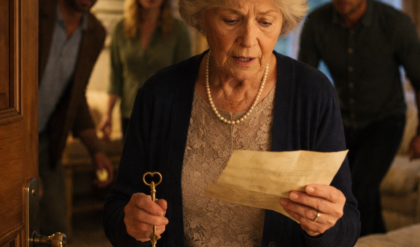
“Could you grab the keepsake box from the study?” I asked him as I adjusted the sleeve of my dress, trying to smooth out a wrinkle that probably only I could see.
“Of course,” he said quickly, already turning away.
Time passed in small, unnoticed increments at first, measured by the movement of people in and out of rooms, by the rise and fall of conversation, by the distant sound of musicians rehearsing in the garden.
Then I realized Gregory had not returned.

At first I smiled to myself, assuming he had gotten distracted, because that was a familiar habit, but as the minutes stretched and something subtle shifted in the rhythm of the house, a quiet unease began to take shape in my chest, the kind that does not announce itself loudly but refuses to be ignored.
I walked downstairs slowly, careful not to disturb the balance of the moment, yet unable to ignore the growing sense that something was not where it should be, that something had slipped just slightly out of place.
The study door was not fully closed.
It stood ajar, just enough to suggest presence without revealing it.
I reached for the handle, hesitated for the briefest moment, and then pushed it open.
There are discoveries that arrive gradually, giving you time to adjust, to process, to prepare.
This was not one of them.
Gregory stood too close to someone he should never have been near in that way, his hands placed with a familiarity that did not belong in that room, in that house, in that life.
And the someone—
Marissa.
Julian’s fiancée.
The young woman I had welcomed into our family with open arms, the one who had sat at my table, laughed in my kitchen, called me for advice, shared stories about her future with my son as if it were something sacred.
She did not pull away.
She did not look surprised.
She leaned into him as if this was not a moment of error, but the continuation of something already established.
The world did not shatter in that instant.
It simply stopped making sense.
I took a step forward without thinking, my body moving before my mind could catch up, every instinct urging me to intervene, to interrupt, to stop what should never have existed.
And then I heard a voice behind me.
“Mom.”
I turned.
Julian stood in the doorway, his expression composed in a way that felt unnatural for the situation, his eyes steady, his posture controlled, as if he had already moved beyond shock into something far more deliberate.
“We need to talk,” I said, my voice unsteady despite my effort to contain it.
“No,” he replied quietly. “We don’t.”
I stared at him, confusion cutting through the initial wave of emotion.
“What do you mean, no? You just saw—”
“I’ve seen enough,” he interrupted, stepping forward, his tone calm in a way that made everything else feel louder by contrast.
“How long?” I asked, the question leaving my mouth before I could stop it.
He reached into his jacket and pulled out his phone.
“Long enough,” he said.
He showed me messages, timestamps, photographs that had been captured not in anger but in patience, evidence gathered over time, each piece adding weight to a truth that could no longer be dismissed as a momentary lapse.
“They thought they were careful,” he continued, his voice steady but not cold. “They weren’t careful enough.”
My legs felt weak, not from the betrayal alone but from the realization that my son had been carrying this knowledge in silence.
“Why didn’t you tell me?” I whispered.
“Because it’s bigger than what you just saw,” he said, meeting my eyes with a clarity that left no room for denial.
“What do you mean?”
He took a breath, then spoke the words that shifted everything from personal betrayal into something far more calculated.
“Dad has been moving money out of your accounts,” he said. “Not recently. Over time. Small amounts, spaced out so it wouldn’t trigger attention. I found the records.”
The room seemed to tilt.
“And Marissa?” I asked, though part of me already understood.
“She helped him,” Julian said. “She has access through her firm. They planned to leave after the wedding. Together.”
There are moments when anger rises so quickly it burns through everything else.
This was not one of them.
What I felt instead was something colder, something sharper, something that settled into place with a kind of clarity I had never experienced before.
“What do we do?” I asked.
Julian’s gaze did not waver.
“We finish what they started,” he said.
I looked at him, truly looked at him, and in that moment I realized he was no longer the boy I had raised but a man who understood exactly what needed to happen and was willing to see it through.
“Your aunt is already involved,” he added.
Right on cue, my sister Caroline stepped into the room, her presence calm but unmistakably purposeful, the years she had spent in investigative work evident in the way she carried herself.
“I’ve documented everything,” she said, placing a folder on the desk. “Financial transfers, communications, patterns. Enough to ensure they can’t walk away from this.”
I closed my eyes for a brief moment, then opened them again with a steadiness I did not know I possessed.
“Then we let them think everything is exactly as it should be,” I said.
Caroline nodded once.
“That would be the most effective approach.”
The ceremony began under a sky so clear it almost felt staged, the late afternoon light casting a golden hue over the garden where rows of white chairs were filled with friends, family, and people who believed they were about to witness a celebration of love.
Gregory stood near the altar, composed, confident, playing his role with a precision that would have been admirable under different circumstances.
Marissa walked down the aisle with a smile that appeared genuine, her expression radiant in a way that might have convinced anyone who did not know the truth.
Julian stood waiting, his posture calm, his gaze steady, his presence unchanged.
If anyone noticed the difference, they did not say it.
The officiant spoke about commitment, about trust, about the future.
Words that carried weight, even when spoken in a context that did not deserve them.
Then came the moment.
“If anyone objects,” the officiant began, his voice smooth and practiced, “speak now—”
“I do.”
The words left my mouth clearly, without hesitation, cutting through the atmosphere like something inevitable.
The silence that followed was immediate and absolute.
Marissa’s expression faltered.
Gregory turned toward me, confusion flashing across his face before being replaced by something closer to concern.
“Lorraine,” he said, forcing a smile. “This isn’t—”
“It is exactly what it needs to be,” I replied.
I stepped forward, feeling the weight of every gaze in the room, every expectation shifting, every assumption beginning to unravel.
“This is not a wedding,” I said. “It is a misunderstanding that has gone on long enough.”
Julian reached into his jacket and handed me a small device.
I pressed the button.
The screen behind the altar flickered to life.
Images appeared.
Not ambiguous, not open to interpretation, but clear, undeniable, and impossible to dismiss.
The reaction was immediate.
Gasps, whispers, the collective intake of breath that signals the moment truth replaces illusion.
Gregory stepped forward.
“Turn that off,” he said, his voice no longer composed.
Julian moved slightly, positioning himself between Gregory and the screen.
“No,” he said quietly.
More images followed.
Financial records.
Transfers.
Patterns that told a story no explanation could erase.
And then the final piece.
A photograph of a young girl, standing in front of a modest house, her expression uncertain but unmistakably connected to the man now standing frozen at the altar.
“Her name is Lila,” I said. “She is Gregory’s daughter. A life he chose to keep hidden.”
The silence that followed was different from before.
Heavier.
More final.
Sirens sounded in the distance, growing louder, approaching with a certainty that mirrored the one now settling over the entire scene.
Caroline stepped forward, already speaking with the officers as they arrived, her voice calm, precise, efficient.
Gregory’s composure collapsed under the weight of everything he could no longer control.
Marissa stood motionless, her earlier confidence gone, replaced by the realization that the future she had planned no longer existed.
And Julian—
Julian remained steady.
Weeks passed.
The aftermath unfolded in ways both expected and unexpected, consequences reaching where they needed to reach, accountability taking shape not through anger but through process.
Gregory faced the results of his actions.
Marissa did the same.
And then, quietly, something else happened.
Lila reached out.
Not with demands, not with expectations, but with uncertainty.
We met her in a small café on a quiet afternoon, and when I looked at her, I did not see betrayal.
I saw a child who had been placed in a situation she did not choose.
Julian spoke to her first, his voice gentle, his presence open.
“You didn’t do anything wrong,” he said.
She nodded, though it was clear she needed time to believe it.
Over time, something new formed.
Not a replacement for what had been lost, but a continuation of what still mattered.
A different kind of family.
A more honest one.
I sold the house the following spring.
Not because I needed to, but because I wanted to begin again in a space that belonged entirely to the life we were building now.
Some endings arrive quietly.
Others arrive all at once.
And sometimes, the ones that feel like destruction are simply clearing the way for something stronger, something truer, something that does not rely on illusion to hold itself together.
On the day that was supposed to celebrate a lie, the truth finally spoke.
And in losing what was never real, we found something that was.